July 4th, 2008 — | Posted by Shane Magee | life -

Things are going haywire at work, your friends are having troubles and you’re being brought into them, you’re wondering where the next money is going to come from - we’ve all had these times in our lives, where bad news never seems to come singly, but in groups! So how do we stay detached and keep our tranquility in the middle of everything?
Control your mind
All negativity first attacks the mind, and it is here that you can have your best defenses against being depressed about it. Too often we waste valuable energy speculating worst-case scenarios about what will happen, and we end up being depressed more from the scenarios that we have invented than the situation as it exists now! We have to train ourselves to focus on what needs to be done, and cut aside any extraenous thinking or worrying. I remember a prayer my mother had pinned up on the kitchen noticeboard ever since I was a child: “Lord, grant me the serenity to accept the things I cannot change, the courage to change the things I can, and the wisdom to know the difference.” My mother wasn’t particularly religious, I guess it was just the profound wisdom contained within the prayer that appealed to her, the same as it does to me.
This is of course easier said than done - the mind can at times seem like a set of wild horses careering down the path of negativity regardless of the effect it has on your happiness. To tame those horses, what is needed is a regular practice of meditation. It won’t make negative thoughts go away overnight, but what it will do over time is strengthen your ability to focus on the here and now and stop mulling over what might never happen.
Keep a perspective
Negative news tends to fill up your entire thinking and crowd out all the positive aspects of life. Don’t let that happen! Keep things in perspective by considering all the blessings you have had so far in your life. We discussed the quality of gratitude a few blog posts back, and we would certainly recommend exploring some of the techniques posted there; it will help you see all the good things in your life as well as the bad.
It’s not the event itself; it’s how you interpret it
Be not afraid
Of destructive actions by others.
But be afraid
Of your own reaction to them.
- Sri Chinmoy
A common psychological model developed in the 1980’s postulated that people who attribute internal, stable and global causes to bad things that happen are much more likely to get depressed about them. What do we mean by that? By internal, we mean blaming ourselves rather than something outside ourselves. By stable, we feel that the current bad situation is going to last forever. And by global, we see this bad thing as evidence of a continuing run of hopelessness - for example saying “Oh, I can’t do anything right” or “it always turns out like that” - rather than seeing it as specific to that particular situation. All these ways of explaining a situation are merely reflex actions of the mind. When we can control our minds, we can accept each situation and deal with it as it is, without attributing blame, without feeling we will be trapped in that situation forever, and without seeing that bad situation as a further indication of how bad life is.
Stay inspired
Happiness is always accompanied by a tremendous sense of expansion - you feel a great sense of goodwill for everyone, and a sense of place in this vast world. In contrast, when bad news strikes, the tendency is to retreat behind the walls of your own castle and separate yourself from everyone; your thinking becomes largely focused on yourself and your predicament. Try every day to have a diet of inspirational reading or watching; this will help in turbulent times to release you from your self absorbed thought-prison and back on the road to actively look for a way forward. Read about other people who faced odds much greater than yours and triumphed. If they can do it, you can do it too!
June 30th, 2008 — | Posted by Tejvan Pettinger | life -

How to Know the Right Thing to Do
There are few greater challenges than working out what is the right thing to do. Sometimes it can appear quite difficult working out what to choose. These are some suggestions for following our inner conscience and creating the life which will give us most satisfaction.
Be Still
To listen to the inner voice, we have to be able to still the mind and quieten our conflicting thoughts. We need to have a faith that something within us we have the wisdom to know our the right thing. To listen to our inner voice, we can try this technique. Repeat the question very carefully in silence and then try to maintain an inner silence for at least 5 minutes; we should not allow any thought to enter, but keep our mind absolutely quiet. At the end of our silent meditation we should have a clearer idea about what to do.
Does it Give You Peace or Anxiety?
If we feel inwardly awkward about a certain course of action, this is a sign that we are doing the wrong thing. When we are doing the right thing, it will be accompanied by a sense of inner peace. Even if others may not appreciate our action, as long as we are acting with the right motives and intentions, we will have a clear conscience and a sense of peace with our decision.
Continue reading →
June 26th, 2008 — | Posted by Shane Magee | productivity -

Concentration is the secret key to a whole world of possibilities, enabling you to keep out distractions and focus on attaining your life goals. In addition it is an absolute prerequisite if you want to learn the art of meditation, as it helps ‘clear the road’ of any mental obstacles. However if anything the average concentration span is decreasing as life gets busier and busier and the world becomes filled with more things to distract and scatter our attention.
Here is one very easy-to-learn concentration excercise which was taught to me by my meditation teacher Sri Chinmoy. It can reap tremendous rewards in terms of clarity, productivity and efficiency in your life, and it can be done with just a few minutes practise every day. People commonly view concentration as purely a mental exercise; but here we are also going use our heart centre, that space in our chest we point to when we say ‘me’ - helping to take some of the burden away from our tension filled minds.
Requirements:
An object of concentration - best is to use a candle or flower, but you can even use a dot on the wall.
Method:
- In this exercise, we will use the candle, although you can adapt the exercise to whatever object you are using. Sit with your back straight, and place the burning candle at eye level.
- First bring your awareness to your breath. Gradually your breath becomes slower and more relaxed. Try to imagine a thread placed in front of our nose; you are breathing so quietly it will not move to and fro.
- Now we look at the object. Gradually bring your attention to a tiny part of the candle flame, for example, the very tip of the flame.
- When you breathe in, feel that your breath, like a golden thread, is coming from that point on the candle and entering into your heart. And when you breath out, feel that your breath, feel that the light is leaving the heart, passing through a point in your forehead between the eyebrows and a little above (in Eastern philosophy this is a powerful concentration point) and then entering into the object of concentration. Try to feel that nothing else exists except you and the object you are focusing on.
- When you do this exercise, thoughts will invariably get in the way. When this happens, don’t be annoyed or upset, just bring your attention back to the exercise. Rome wasn’t built in a day, and similarly it will take time to rein in your mind.
- (if you have the time) You can go one step further, and use your power of concentration to identify with the object’s existence. Try to feel on the inbreath that the existence of the flame, and the qualities it embodies such as radiance, serenity and aspiration, are entering into you and becoming part of your own existence. On the outbreath, feel that your existence is expanding and spreading out from the centre of the chest and entering into the candle. In this way, you concentrate on the object to such an extent that you feel no separation between you and the object; your existence has expanded to include the candle. In this way you can identify ourself with the entire world.
Start off with a modest goal - i.e 3-5 minutes a day, and then gradually increase with time. After only a couple of weeks of doing this exercise, you should notice the progress - a clearer mind, better ability to cope with tasks, less stress, more serenity.
If you are inspired to try, please let us know how you got on! Good luck!
June 23rd, 2008 — | Posted by Tejvan Pettinger | life -

“At the end of the sorrowful night
Truth appears and smilingly says,
“Beloved, fear no more.”
- Sri Chinmoy
The material advances of the world do not seem to have reduced the amount of fear that exists in our mind. When we fear we weaken ourselves and make it impossible to enjoy life as it is supposed to be enjoyed. To consciously enjoy life we need to throw away fear and retain optimism and a positive attitude to the world. To live without fear is quite possible.
Self Belief.
When we fear we consciously weaken ourselves. If we think of ourselves as an ant, then we will inevitably fear being trampled on. It is important to maintain faith in ourselves and a sense of self belief. This is not the pride of self aggrandisement, but belief in our inner self. If we maintain belief in our inner divinity, then we will not fear the world.
Don’t Judge Others
When we judge and condemn others, we ironically open ourselves upto being judged ourselves. When we pick up on the faults of others, we unconsciously strengthen these very same faults in ourself. Often we start criticising others to assert an unconscious sense of superiority over others; we do this partly out of fear. But, judging others is not a solution to fear; we only make it stronger.
Don’t Focus on Your Weakness / Sin.
If we focus on our ’sins’ and weaknesses, we start to cherish a guilty conscience. This magnifies our weaknesses and problems, this will only create an attitude of fear. Instead we need to forget unpleasant experiences; it is sufficient to resolve to avoid repeating mistakes. We need to move on and think about the good things we are going to do. When we focus on the negative things we have done we become fearful of their consequences.
Continue reading →
June 19th, 2008 — | Posted by Shane Magee | happiness, simplicity -

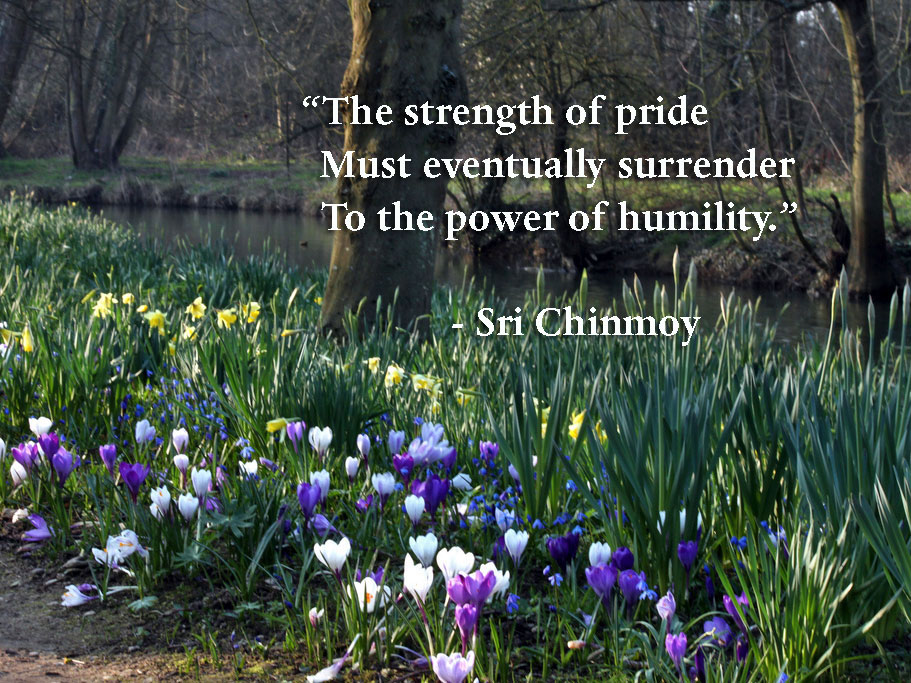
Last week I wrote about gratitude, sharing my experience of how contrary to its associations with meekness, it can in fact be a form of unexpected power. Humility, if anything, is a quality that has even more of those mild saintly associations, leading us to think of doormats who turn the other cheek no matter what who is trampling all over them. And yet (surprise, surprise) nothing could be further than the truth, and here’s why….
First of all we need exactly to define what humility is. Because our ego often gives rise to excessive overpromotion, we feel that humility therefore involves the opposite extreme - publicly castigating ourselves and laying on excessive lashings of forced modesty. Yet the underlying feeling behind this kind of behaviour is insecurity and a desire to have others think better of us, and as such is just as much a manifestation of ego as excessive aggrandisement.
Humility is, quite simply, what happens when we go beyond the ego - a sincere and genuine self-appraisal, taking into account the entire being, all the faults and good points alike. As meditation teacher Sri Chinmoy points out “When you take a back seat consciously and deliberately in order to show others how humble you are, you are not being humble at all. True humility is something different; it is the feeling of oneness. Humility means giving joy to others. When we allow others to get joy, we feel our joy is more complete, more perfect, more divine.”
Continue reading →
June 18th, 2008 — | Posted by Tejvan Pettinger | story -

“Nothing is Worth More than this day
- J.Goethe
A rich man was very attached to his wealth and money. A sufi saint approached him and asked him this question.
“If you were dying of thirst in the desert, would you give half of your wealth for a glass of water?”
The rich man replied “Yes.”
The Saint then asked the rich man, “if you were in agony because you could not pass this water, would you spend half of your wealth to be able to pass the water?”
The rich man replied “yes”
So the Sufi saint said, “Why do you attach so much importance to your wealth when you would give up your entire kingdom and material possessions for a glass of water you don’t even get to keep?”
Analysis
Material wealth is neither good nor bad. What is important is how it is used and our attitude towards it.
A knife can be used to stab someone or cut an apple in half to share. Similarly, money can be used to improve our material wellbeing; but it can also destroy a person.
If the accumulation of wealth is our highest priority we will be seeking happiness in ephemeral way; we will be doomed to disappointment. Furthermore, when we become possesed with the desire to accumulate wealth, we invariably become mean, selfish and self-absorbed. In this story the sufi saint reminds us of the transitory nature of the world. No matter how much wealth we accumulate in this life, we can not take it with us - nor does wealth help us to understand the deeper meaning of life.
Posts related to Wealth and happiness
June 16th, 2008 — | Posted by Shane Magee | life -

There are few greater sources of frustration and unhappiness than the feeling that your journey to happiness is being delayed by the demands and opinions of others. What makes it worse is that these demands often come from from the people close to you - parents, siblings and friends. So how can you navigate this web of demands and still follow your dreams? We offer a few observations on the matter:
Remember that other people’s opinions very often stem from their own insecurities. If you have the inner inspiration to do something new or to drop an old destructive habit, this can easily be seen by other people as a challenge to their way of thinking. Explain politely but firmly that what they are doing might be perfectly fine for them, but not for you.
Beware of people telling you you have to be realistic. Often their ‘realism’ is defined by the experiences they have had - we generaly tend to move in tight circles of where negative thoughts are confirmed by negative experiences and positive thoughts are confirmed by positive experiences - in many ways our thoughts really do shape the world we see. So if you are planning to take a step into the unknown, bear in mind other people might have built a whole life on ‘playing it safe’ and that is all they know. Often it is best not to get into direct confrontation, but instead ‘humour’ them by saying things like ‘you are just trying this option out for a little while’ whilst at the same time quietly and firmly going about your own thing. Continue reading →
June 11th, 2008 — | Posted by Tejvan Pettinger | life -

In our recent post - Who Am I? We looked at the idea of transcending the ego.
However, as a reader pointed out - is it not better to understand the ego from a peaceful perspective rather than abolishing the ego?
I would suggest that to transcend the ego completely is a very lofty goal; and in practice very difficult. It is one thing to say ‘I will transcend all concept of ego’, but, to do it is a completely different matter.
In the beginning we need to be wise and deal with our present limitations. We should not expect to transcend our ego with a few meditations; it is like thinking about doing a master’s course whilst we are still in primary school. To graduate with a Master’s degree we need to go through all the levels of schooling before we can even begin to start our Master’s course. It is the same with spirituality. Just thinking of the idea of Nirvana doesn’t really help, because it is so far from our present stage of evolution. What we can do is to gradually change our nature. We can gradually become less selfish, materialistic and inward looking. We can consider the needs of others and try to expand our consciousness. If we can develop humility, simplicity and selflessness, then slowly we will transform our nature. Rather than trying to completely transcend the ego; we make the ego less selfish. This is an effective way to make progress. When we work on our ego, there will come a point in the future, when we can make the leap to transcending the ego.
Dealing With Conflicts in Relationships
A strong ego can often cause conflicts in relationships. In this guest post at Pick The Brain,- How To Deal with Conflicts in Relationships I looked at a few strategies to improve our relationships with others.
How to Reduce the Ego - Another post looking at how to reduce the ego.
Picture courtesy of Australian World Harmony Run 2008
June 9th, 2008 — | Posted by Shane Magee | inner peace -

In today’s fast moving world, qualities such as gratitude seem to belong to another age - a simpler time when life moved along at an easier pace and there was time to appreciate everything. Yet within this apparently meek sounding quality there lies a tremendous source of power that can radically reshape the way you look at the world.
What gratitude can do for us:
- Puts things in perspective: Human beings have this self-defeating propensity to let the bad things in life fill our mental vision and leave no room for the good, a tendency reflected and perpetuated by television and newspapers. Often it takes just one bad thing to happen for us dwell on it and get depressed, no matter how many good things that are happening. In cultivating a daily practice of gratitude, we start to reverse that process and gain a true perspective on life.
- Lifts us above the ebbs and tides of life: The more you develop the quality of gratitude in your life, you will start feeling grateful even when bad things happen to you, because you will have developed the inner vision to see that good things and bad happenings are nothing but experiences to shape you and make you stronger. Hence you will be able to have piece of mind no matter what the outer circumstances are.
- Takes us out of our limited ego: As with other practices of self-discovery, your awareness expands and you gradually feel you are part of something much more infinite than your limiting ego and finite mortal frame. Gratitude helps us turn away from self-centredness and realise our place in the universe.
- Awakens a higher part of our being: Gratitude is primarily a quality felt by the heart centre, that place in the middle of our chest where we can feel our soul, or the essence of our existence. Therefore, when we are consciously grateful, some inmost part of ourselves is awakened and we enter into the higher and nobler realms of our being.
Continue reading →
June 6th, 2008 — | Posted by Tejvan Pettinger | story -

There was a very rich man, who was also very miserly. His only joy was in the accumulation of money. Somehow, he had managed to marry a beautiful wife, who was also very generous and kind hearted. As you might expect the miser was deeply unpopular, but, everyone liked and admired his self giving wife. However, she thought. “Since, he is my husband and no one else likes him, what can I do? I, at least, must be kind to him and offer him my support. Despite, receiving no praise from her miserly husband, she served him night and day.
Then a famine struck the region. The miser gave nothing. But, his wife tirelessly travelled the region offering help and lending people money to buy rice. The people who borrowed money wanted to pay back the wife; but, she refused saying.
“It’s fine, I don’t need the money. Please keep it.”
But, the people refused saying ‘no we really want to give it back, when we can.’
So she said something quite surprising. “If you really want to repay me, then give me the money the day my husband dies.”
Continue reading →